
Beginner’s Guide to Building a Golf Set
I've spent 20 years making expensive mistakes so you don't have to. Here's how to build a bag from scratch, the right way.
The First Rule: Never Buy a Complete Set
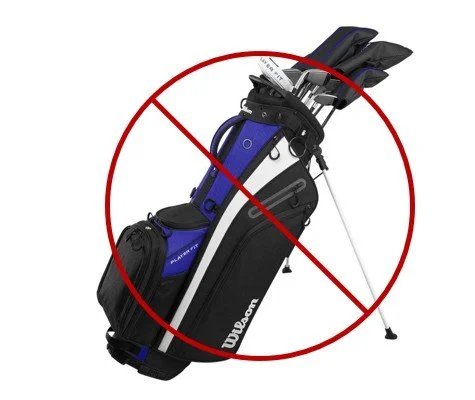
This is non-negotiable. Here's why it is a lose-lose:
If you buy a complete set and quit golf, you've spent $500-$1,000 on something with essentially zero resale value. If you buy a complete set and fall in love with golf, you'll outgrow it within 6 months and those woods will be snapping before you know it. Either way, you lose.
Buy Used. Always.
Sites like Global Golf, 2nd Swing, and the pre-owned sections at PGA Superstore and Golf Galaxy are where smart golfers shop. The OEMs, TaylorMade, Callaway, Titleist, etc. have built entire marketing machines around convincing you that newer means better. It doesn't. You need to remind yourself that these companies are either publicly traded or private equity backed. They need to grow their topline to generate a return on investment for their investors, and target green grass golfers to do so. Second-hand golf is thriving precisely because educated golfers have figured this out.
On fittings: companies will tell you that you need one before you buy anything. Why do they want you to get fit? Because they only fit for their newest, most expensive clubs. The truth is that if you can't hit the center of the face 60% of the time, a fitting is largely just a swing speed test. There is no club on earth that fixes inconsistent contact. Go to the range and hit 100 balls a day for a month, two months, a year even. That will do more for your game than any new driver, guaranteed. The return on investment will be far greater than a brand new $600 driver. For now, if you swing hard and hit the ball very far, go stiff or x-stiff. If you swing slow, go regular. Don't overthink it.
Building Your Bag
Irons — Start here. Find any set of cavity backs from a reputable brand on a pre-owned site. Avoid Top Flites and anything that looks like it was bought at a garage sale or being resold from a complete set. Pay attention to shaft length, most sites will indicate if clubs are standard, longer, or shorter than stock. There are charts online to help you find the right fit for your height. I am 6 feet tall and find stock iron shafts to be the perfect length.
Wedge — Get a 56 or 60 degree. You'll eventually want both, so just grab whichever fits your budget in decent condition from a reputable brand. Don't overthink this one.
Putter — Go to a store, feel a few out, and see what looks right to your eye. Then find the same or comparable model online for less.
Driver — Last priority, not first. Stock driver shafts run long, so use a similar guide as your irons to determine if you want your clubs a quarter to half an inch shorter. Go with 10.5 degrees to help get the ball airborne. Older models are still very good, don't let anyone convince you otherwise. With those two criteria, just go for whatever fits your budget.
At this point you have a Driver, Irons, a Wedge, and a Putter. You'll fill in the gaps over time (e.g. fairway woods, hybrids, additional wedges) but this setup will outperform any complete set at the same or lower price point, and it will last.
Accessories
Bag — eBay and Facebook Marketplace are your friends here. If you ride, weight doesn't matter. If you walk, keep it light. The 14-divider bags look organized but weigh a ton. A classic 3-divider stand bag is all you need.
Balls — Free. Head out to your local course in the evening and walk the edges of a driveable par 4. You'll find plenty. At this stage of your game, playing the same ball doesn't matter, consistent contact matters. Same goes for tees. Forage at the tee box. One thing that should go without saying: don't steal range balls. It's low-class and they spin inconsistently anyway.
Shoes — Worth spending on. Golf shoes are a genuine "you get what you pay for" product. A few criteria that I look out for when shopping are weatherability (i.e. waterproof), durability, traction (i.e. spiked vs. spikeless), and stability. Nike and FootJoy both make solid entry-level options.
Gloves — Buy whatever fits. Kirkland gloves are inexpensive and hold up well. Put it back in the sleeve after every round and a single glove can last you an entire season.
Miscellaneous — Get a groove cleaner and a towel. Clean your clubs. It's one of those small things that quietly affects your ball striking more than you'd expect. My personal recommendations are linked in the My Favorites section.
Last step. Don’t underestimate driving range and short game practice.